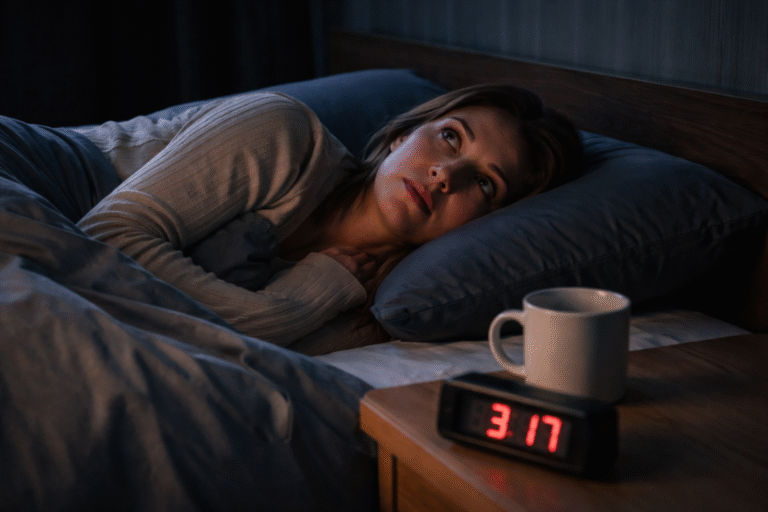
Why You Can’t Focus: How Sleep Affects Memory, Productivity, and Brain Health
Sleep Is One of the First Things Behind Good Focus

You sit down to work, open the document, and realize you have read the same sentence three times. Your mind keeps drifting. You try harder, remove distractions, and push yourself to concentrate, but your brain still feels slow, foggy, and unreliable.
That experience is often blamed on a lack of motivation or discipline. Sometimes, though, the problem is biological. Research consistently shows that insufficient or poor-quality sleep impairs sustained attention, executive control, memory formation, and day-to-day cognitive efficiency. Sleep is not passive downtime. It is an active biological process that supports learning, emotional regulation, decision-making, and overall brain function (Hudson et al., 2020; Krause et al., 2017; Watson et al., 2015).
Sleep Is One of the First Things Behind Good Focus
One of the most consistent findings in sleep research is that attention declines quickly when sleep is restricted. A meta-analysis of short-term sleep restriction found significant neurocognitive impairment overall, with especially strong effects on sustained attention and executive functioning (Lowe et al., 2017). Review-level evidence also shows that vigilant attention is highly sensitive to sleep deprivation, with slower responses, greater variability, and more lapses in performance when people are sleep deprived (Hudson et al., 2020).
This matters because sustained attention is the kind of focus required for reading, studying, meetings, driving, writing, and most forms of mentally demanding work. Research also suggests that not every attention system is affected equally: alerting and executive control are more consistently impaired, while some orienting processes may be relatively less disrupted under certain conditions (García et al., 2021; Riontino & Cavallero, 2022). In practical terms, people may still manage familiar or automatic tasks while tired, yet struggle disproportionately with work that requires planning, conflict resolution, or resistance to distraction.
Why “Trying Harder” Often Does Not Work
Sleep loss does not simply make people less willing to focus. It makes the brain less able to maintain stable performance. Reviews of the field describe this as state instability: performance fluctuates, with brief periods of relative stability interrupted by sudden attentional failures (Hudson et al., 2020; Krause et al., 2017).
There is also direct evidence that local, sleep-like brain activity can intrude into wakefulness. In one study, these sleep-like slow waves predicted attentional lapses, mind-wandering, mind-blanking, and missed responses, helping explain why sleep-deprived people often feel as if their brain is “shutting off” despite effort (Andrillon et al., 2021). This is one reason that “just trying harder” often fails when sleep is inadequate: the very systems needed for top-down control are among the most sleep-sensitive.
Sleep Is Part of Learning, Not Just Recovery After It
Sleep affects memory from both directions. Sleep before learning helps the brain encode new information efficiently. Sleep after learning helps consolidate that information, making it more stable and easier to retrieve later. A 2024 systematic review and meta-analysis found that restricting sleep to roughly 3 to 6.5 hours negatively affected memory formation, with evidence that insufficient sleep before encoding is particularly harmful (Crowley et al., 2024). Reviews of the sleep and memory literature likewise conclude that sleep loss impairs learning, working memory, and long-term memory processes (Krause et al., 2017).
This means poor sleep can reduce how much you learn in the moment and how much you retain afterward. That applies to both declarative memory, such as facts and concepts, and procedural learning, such as skills and repeated task performance. For students, workers, and anyone doing cognitively demanding tasks, more waking hours do not necessarily translate into better learning if sleep is sacrificed in the process.
Productivity Drops Even Before Total Exhaustion
Many people judge sleep by whether they can stay awake through the day. But being awake is not the same as functioning well. The research base consistently links sleep loss to more errors, slower reaction time, weaker inhibition, and poorer performance on demanding cognitive tasks (Hudson et al., 2020; Lowe et al., 2017).
Experimental evidence also suggests that adequate sleep can support measurable cognitive gains. In a 2024 study of healthy adults, consistent sleep of at least seven hours per night was associated with improvements in working memory and inhibitory control beyond what would be expected from simple practice. In contrast, insufficient sleep prevented those gains from emerging (Zimmerman et al., 2024). This supports the broader conclusion that sleep helps determine whether the brain performs efficiently over time.
Brain Fog Has a Biological Basis
“Brain fog” is not a formal diagnosis, but the experience is real. Sleep deprivation reduces efficiency in neural systems involved in attention, working memory, self-control, and decision-making, especially within prefrontal and broader attention-related networks (Krause et al., 2017; Hudson et al., 2020). That is why poor sleep can feel like procrastination, forgetfulness, or low motivation when the underlying issue is reduced cognitive capacity.
Sleep and Long-Term Brain Health
The strongest consensus is around short-term cognitive effects: insufficient sleep reliably worsens attention, memory, and executive function. The long-term story is more nuanced. Large observational studies suggest that both shorter and longer sleep durations are associated with worse cognitive performance and differences in brain structure, with about seven hours associated with the best cognitive outcomes in middle- to later-life adults (Tai et al., 2022). However, these findings are associational, not definitive proof that changing sleep alone will prevent long-term cognitive decline.
Even so, major reviews argue that sleep is central to brain maintenance. Sleep is involved in coordinated neuronal activity, fluid movement, and clearance-related processes that may be relevant to neurodegeneration and dementia risk (Lewis, 2021). The broad scientific consensus is that sleep is a core pillar of brain health, while the exact causal pathways linking disrupted sleep to later neurodegenerative disease remain an active area of research (Krause et al., 2017; Lewis, 2021).
What This Means in Real Life
For most adults, adequate sleep is not a luxury or reward for finishing work. It is part of the mechanism that makes focused work possible in the first place. Major sleep-medicine guidance states that adults should sleep 7 or more hours per night regularly to promote optimal health, while routinely sleeping less than seven hours is associated with adverse health and performance outcomes (Watson et al., 2015). Individual sleep needs vary, but for many people, treating sleep as optional creates a hidden, recurring cognitive handicap.
At the same time, not every focus problem is caused by sleep. Concentration difficulties can also reflect anxiety, depression, ADHD, medication effects, substance use, burnout, insomnia disorder, sleep apnea, restless legs syndrome, or other medical conditions. Sleep is one of the most important and modifiable contributors, but it is not the only one.
Conclusion
When you cannot focus even though you are trying, the problem may not be a lack of effort. It may be sleep.
The current best evidence indicates that insufficient sleep impairs sustained attention, executive control, memory formation, and cognitive efficiency. Meta-analyses, reviews, and experimental work strongly support those short-term effects. Over the longer term, poor sleep is also associated with worse cognitive and structural brain outcomes, although those findings should be interpreted carefully because much of that literature is observational. Taken together, the evidence supports a clear practical conclusion: protecting sleep is one of the most effective ways to support attention, learning, productivity, and brain health.
When to See a Doctor
Talk with a healthcare professional if you:
- regularly spend enough time in bed but still wake unrefreshed
- have persistent insomnia, frequent awakenings, or excessive daytime sleepiness
- snore loudly, gasp, choke, or stop breathing during sleep
- Notice concentration or memory problems affecting work, school, driving, or safety
- have sleep problems along with worsening mood, fatigue, or other physical symptoms
Medical Disclaimer
This article is for educational purposes only and is not medical advice. It does not diagnose, treat, or prescribe for any condition. Sleep problems, fatigue, and trouble concentrating can have many different causes. Personal decisions about symptoms, testing, or treatment should be made with a qualified healthcare professional.
References
Andrillon, T., Burns, A., MacKay, T., Windt, J., Bellgrove, M. A., & Tsuchiya, N. (2021). Predicting lapses of attention with sleep-like slow waves. Nature Communications, 12(1), 3657. https://doi.org/10.1038/s41467-021-23890-7
Crowley, R., Alderman, E., Javadi, A.-H., & Tamminen, J. (2024). A systematic and meta-analytic review of the impact of sleep restriction on memory formation. Neuroscience & Biobehavioral Reviews, 167, 105929. https://doi.org/10.1016/j.neubiorev.2024.105929
García, A., Del Ángel, J., Borrani, J., Ramírez, C., & Valdez, P. (2021). Sleep deprivation effects on basic cognitive processes: Which components of attention, working memory, and executive functions are more susceptible to the lack of sleep? Sleep Science, 14(2), 107–118. https://doi.org/10.5935/1984-0063.20200049
Hudson, A. N., Van Dongen, H. P. A., & Honn, K. A. (2020). Sleep deprivation, vigilant attention, and brain function: A review. Neuropsychopharmacology, 45(1), 21–30. https://doi.org/10.1038/s41386-019-0432-6
Krause, A. J., Ben Simon, E., Mander, B. A., Greer, S. M., Saletin, J. M., Goldstein-Piekarski, A. N., & Walker, M. P. (2017). The sleep-deprived human brain. Nature Reviews Neuroscience, 18(7), 404–418. https://doi.org/10.1038/nrn.2017.55
Lewis, L. D. (2021). The interconnected causes and consequences of sleep in the brain. Science, 374(6567), 564–568. https://doi.org/10.1126/science.abi8375
Lowe, C. J., Safati, A., & Hall, P. A. (2017). The neurocognitive consequences of sleep restriction: A meta-analytic review. Neuroscience & Biobehavioral Reviews, 80, 586–604. https://doi.org/10.1016/j.neubiorev.2017.07.010
Riontino, L., & Cavallero, C. (2022). Impact of sleep deprivation on attentional networks: Disentangling orienting components. Brain and Cognition, 159, 105863. https://doi.org/10.1016/j.bandc.2022.105863
Tai, X. Y., Chen, C., Manohar, S., & Husain, M. (2022). Impact of sleep duration on executive function and brain structure. Communications Biology, 5, 201. https://doi.org/10.1038/s42003-022-03123-3
Watson, N. F., Badr, M. S., Belenky, G., Bliwise, D. L., Buxton, O. M., Buysse, D., Dinges, D. F., Gangwisch, J., Grandner, M. A., Kushida, C., Malhotra, R. K., Martin, J. L., Patel, S. R., Quan, S. F., & Tasali, E. (2015). Recommended amount of sleep for a healthy adult: A joint consensus statement of the American Academy of Sleep Medicine and Sleep Research Society. Sleep, 38(6), 843–844. https://doi.org/10.5665/sleep.4716
Zimmerman, M. E., Benasi, G., Hale, C., Yeung, L.-K., Cochran, J., Brickman, A. M., & St-Onge, M.-P. (2024). The effects of insufficient sleep and adequate sleep on cognitive function in healthy adults. Sleep Health, 10(2), 229–236. https://doi.org/10.1016/j.sleh.2023.11.011