Does Caffeine Ruin Your Sleep? What the Science Actually Says.
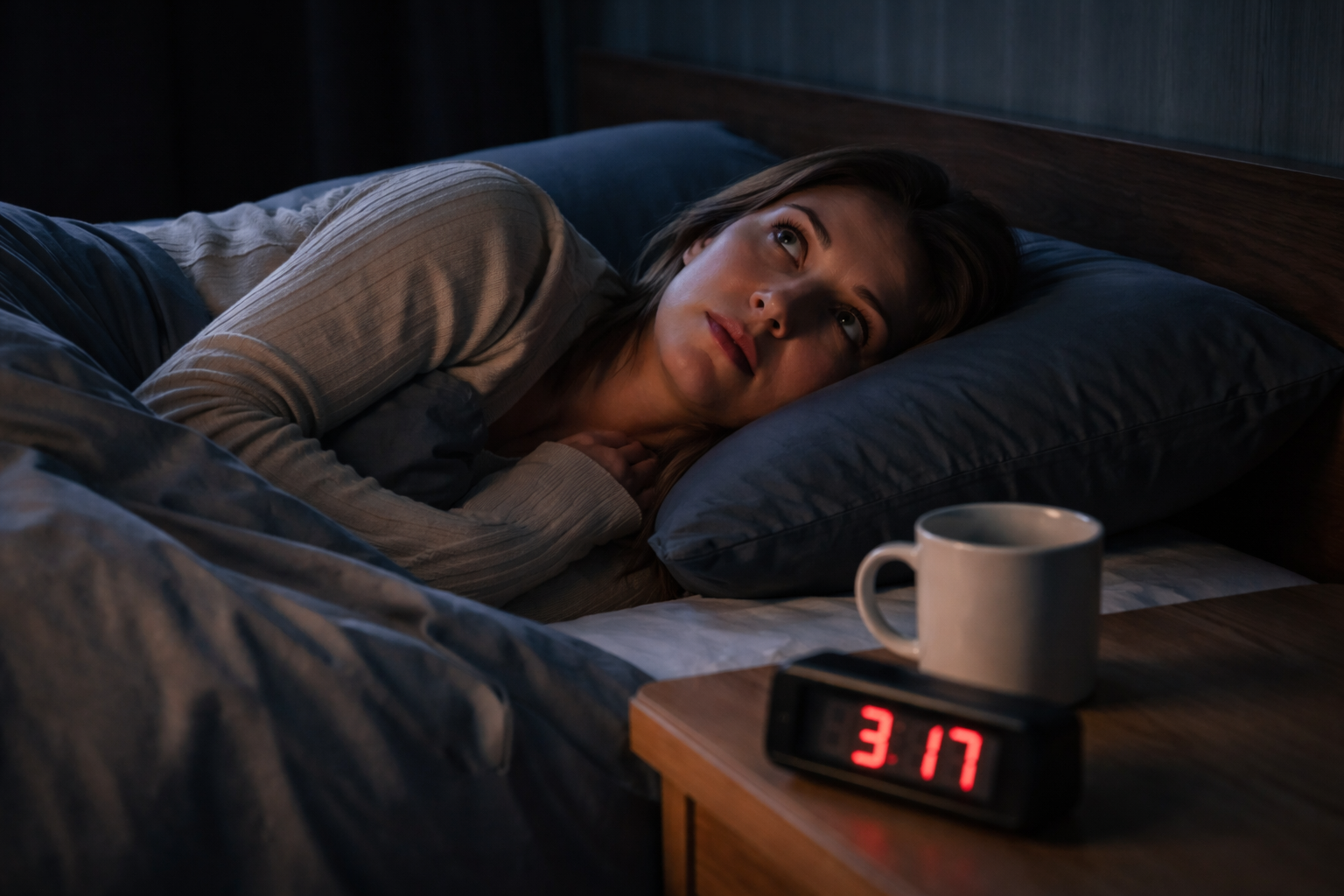
You had your last cup of coffee at 3 p.m. You fell asleep at a reasonable hour. You woke up feeling groggy, unrested, and more tired than you expected. Sound familiar?
Most people blame stress, a busy mind, or “just not being a good sleeper.” What they rarely suspect is the mug they set down six or seven hours before bed. But the science is clear: caffeine is disrupting far more sleep than people realize, and the tricky part is that you often cannot feel it happening.
This article breaks down exactly how caffeine affects your sleep, why timing matters more than you think, and what the research says about when your last cup should actually be.
How Caffeine Works Against Sleep
To understand why caffeine disrupts sleep, you need to understand adenosine, a chemical that builds up in your brain throughout the day and creates what scientists call “sleep pressure.” The longer you are awake, the more adenosine accumulates, and the sleepier you feel. This is your body’s natural signal that it is time to rest.
Caffeine works by blocking adenosine receptors. It does not eliminate fatigue or reduce adenosine levels; it simply binds to the same receptor sites and prevents adenosine from doing its job. You feel more alert, but the sleepiness signal is still there, waiting. Once caffeine is metabolized and cleared from those receptors, adenosine floods back in, which is why the post-caffeine crash can feel so sudden and severe.
The problem with sleep is that caffeine has a half-life of approximately five to six hours in most healthy adults. This means that if you drink a cup of coffee with 100 mg of caffeine at 3 p.m., roughly 50 mg is still circulating in your system at 9 p.m. That is enough to keep adenosine receptors partially blocked right when your body is trying to initiate and deepen sleep.
What Caffeine Actually Does to Your Sleep Architecture
Sleep is not one continuous, uniform state. It cycles through distinct stages: light sleep, deep sleep (also called slow-wave sleep), and REM sleep, each serving critical functions for physical recovery, memory consolidation, and emotional regulation. Caffeine disrupts several of these stages in ways that go far beyond simply making it harder to fall asleep.
Research consistently shows that caffeine:
- Reduces total sleep time
- Lowers sleep efficiency (the percentage of time in bed actually spent asleep)
- Increases how long it takes to fall asleep (sleep onset latency)
- Decreases deep, restorative slow-wave sleep
- Increases the proportion of light sleep stages
A 2023 systematic review and meta-analysis, one of the most rigorous studies on this topic, confirmed these findings across multiple clinical trials. The review recommended that caffeine intake should stop at least 8.8 hours before bedtime to avoid measurable reductions in sleep quality. For most people, targeting a 10 p.m. bedtime means cutting off caffeine by around 1 p.m.
Deep sleep is particularly vulnerable. Slow-wave sleep is when your body does its most intensive physical repair, releasing growth hormone, consolidating memories, and restoring energy. When caffeine suppresses this stage, you may still technically sleep eight hours, but wake up feeling like you only got five.
The Dose-and-Timing Problem
Not all caffeine consumption is equally disruptive. The damage depends heavily on two factors: how much you consume, and when you consume it relative to your bedtime.
A 2024 randomized, crossover clinical trial tested what happens when participants consumed 400 mg of caffeine (roughly equivalent to four standard cups of coffee) at varying intervals before bed. The results were striking: caffeine consumed close to bedtime caused significant sleep disruption, but even doses taken 12 hours before sleep had measurable negative effects at higher amounts. The closer to bedtime and the higher the dose, the worse the outcomes.
For reference, common caffeine amounts in popular beverages include: a standard 8 oz cup of brewed coffee (95–120 mg), an espresso shot (63 mg), a 16 oz energy drink (160 mg or more), and a 12 oz can of cola (34–46 mg). It is easy to accumulate several hundred milligrams throughout a day without realizing it, and each increment extends the window of disruption.
The Hidden Disruption: Why You Cannot Trust How You Feel
Here is what makes caffeine’s effect on sleep especially deceptive: your subjective perception of sleep quality is often disconnected from what is actually happening in your brain.
Multiple studies have demonstrated that people consistently underestimate how much caffeine has affected their sleep. A 2013 study published by Drake and colleagues showed that caffeine taken six hours before bedtime significantly disrupted objective sleep measures. Yet, participants did not fully perceive how disturbed their sleep was. They woke up feeling like their sleep was normal, even while data showed meaningful reductions in sleep quality and duration.
This disconnect happens in part because caffeine also suppresses the subjective feeling of sleepiness. You do not notice how tired you are, which makes it harder to assess how your sleep felt accurately, and it makes it easy to dismiss the idea that your afternoon coffee had anything to do with waking up groggy.
This is why healthcare providers and sleep researchers emphasize objective tracking, sleep diaries, wearables, and clinical sleep studies, rather than relying on how someone “thinks” they slept after caffeine exposure.
Caffeine and Your Internal Clock
Beyond blocking adenosine, caffeine also interacts with your circadian rhythm, the 24-hour internal clock that governs your sleep-wake cycle, hormone release, body temperature, and dozens of other biological functions.
A landmark 2015 randomized controlled trial found that consuming caffeine in the evening delays melatonin release. This hormone signals to your body that it is nighttime approximately 40 minutes earlier. That may not sound like much, but over weeks and months, consistently delaying melatonin onset shifts your entire sleep timing later, making it harder to fall asleep at your intended bedtime and harder to wake up feeling refreshed in the morning.
Regular daytime caffeine use has also been shown to delay circadian REM sleep promotion, the biological timing of REM sleep cycles, contributing to worsening overall sleep quality even when caffeine is consumed hours before bed. In short, caffeine does not just affect the night you drink it. It gradually nudges your entire biological clock in the wrong direction.
Special Considerations: Adolescents and Individual Variation
Adolescents Are Especially Vulnerable
Research specifically focused on teenagers shows that afternoon and evening caffeine consumption impairs multiple dimensions of sleep health, not just duration, but sleep efficiency, slow-wave sleep, and circadian timing. A 2021 observational study found that adolescents who consumed caffeine in the afternoon and evening had significantly reduced sleep efficiency, which, in turn, led them to consume more caffeine the next day, forming a self-reinforcing cycle with concerning long-term implications for developing brains and bodies.
Given that adolescents are already biologically predisposed to sleep timing later (a circadian shift that begins in puberty), adding caffeine to the equation compounds an already challenging situation.
Not Everyone Is Affected the Same Way
Genetics plays a meaningful role in caffeine sensitivity and metabolism. Variations in the CYP1A2 gene affect how quickly caffeine is broken down in the liver; some people metabolize it rapidly (fast metabolizers), while others process it much more slowly (slow metabolizers). If you are a slow metabolizer, a cup of coffee at noon may still be significantly affecting your sleep at midnight.
Age also matters. Caffeine metabolism generally slows with age, meaning older adults are typically more sensitive to caffeine’s sleep-disrupting effects. Additionally, habitual caffeine users develop some tolerance to its stimulant effects, but research suggests this tolerance does not fully extend to its sleep-disrupting impact. Even regular coffee drinkers experience measurable changes in sleep architecture after late-day caffeine consumption.
Evidence-Based Recommendations
Based on the available research, here is what sleep scientists and clinicians currently recommend:
- Stop caffeine at least 8–9 hours before your target bedtime. For a 10 p.m. bedtime, that means no caffeine after 1–2 p.m.
- Higher doses require longer lead times. If you are consuming 400 mg or more in a day, consider a 12-hour buffer.
- Do not trust how you feel as your only measure. Track your sleep objectively for 2 weeks, with and without afternoon caffeine, using a wearable or a sleep diary.
- Know your personal sensitivity. If you are an older adult, a slow caffeine metabolizer, or an adolescent, you may need to cut off even earlier.
- Watch total daily intake. It is not just about timing; cumulative dose across the day matters too.
The Bottom Line
Caffeine is one of the most widely consumed psychoactive substances in the world, and for most healthy adults in reasonable amounts, it is safe. But its interaction with sleep is more complex and longer-lasting than most people appreciate.
The research is consistent: caffeine reduces total sleep time, suppresses deep sleep, increases sleep fragmentation, delays melatonin release, and shifts circadian timing, all in ways that people often cannot subjectively detect. The “I can drink coffee at 5 p.m. and sleep fine” belief is, for most people, a perception problem rather than a physiological truth.
If you have been waking up feeling unrested despite sleeping a full night, your afternoon coffee routine deserves a closer look. The fix might be simpler than you think, and far more powerful.
References
1. Gardiner, C., Weakley, J., Burke, L. M., Roach, G. D., Sargent, C., Maniar, N., Townshend, A., & Halson, S. L. (2023). The effect of caffeine on subsequent sleep: A systematic review and meta-analysis. Sleep Medicine Reviews, 69, Article 101764. https://doi.org/10.1016/j.smrv.2023.101764
Meta-analysis (n = 24 studies). Caffeine reduced total sleep time by 45 min, sleep efficiency by 7%, increased sleep onset latency. Coffee (107 mg/250 mL) should be consumed ≥8.8 h before bedtime. PMID: 36870101
2. Gardiner, C. L., Weakley, J., Burke, L. M., Fernandez, F., Johnston, R. D., Leota, J., Russell, S., Munteanu, G., Townshend, A., & Halson, S. L. (2025). Dose and timing effects of caffeine on subsequent sleep: A randomized clinical crossover trial. Sleep, 48(4), zsae230. https://doi.org/10.1093/sleep/zsae230
RCT (n = 23 males). 100 and 400 mg caffeine tested at 4, 8, and 12 h before bedtime. 400 mg caused negative sleep effects within 12 h of bedtime; greater disruption closer to bedtime. Published online October 8, 2024. PMID: 39383481
3. Drake, C., Roehrs, T., Shambroom, J., & Roth, T. (2013). Caffeine effects on sleep taken 0, 3, or 6 hours before going to bed. Journal of Clinical Sleep Medicine, 9(11), 1195–1200. https://doi.org/10.5664/jcsm.3170
RCT (n = 12). Fixed 400 mg dose at 0, 3, and 6 h pre-bedtime, all significantly disrupted sleep vs. placebo. Supports ≥6 h caffeine-free period before bed. PMID: 24235903
4. Burke, T. M., Markwald, R. R., McHill, A. W., Chinoy, E. D., Snider, J. A., Bessman, S. C., Jung, C. M., O’Neill, J. S., & Wright, K. P., Jr. (2015). Effects of caffeine on the human circadian clock in vivo and in vitro. Science Translational Medicine, 7(305), 305ra146. https://doi.org/10.1126/scitranslmed.aac5125
Within-subject RCT (~49-day protocol). Double-espresso caffeine dose 3 h before bedtime delayed circadian melatonin rhythm by ~40 min. Effect mediated by adenosine receptor/cAMP signaling. PMID: 26378246
5. Clark, I., & Landolt, H. P. (2017). Coffee, caffeine, and sleep: A systematic review of epidemiological studies and randomized controlled trials. Sleep Medicine Reviews, 31, 70–78. https://doi.org/10.1016/j.smrv.2016.01.006
Systematic review of epidemiological studies and RCTs. Confirmed dose- and timing-response relationships. Older adults and individuals with certain genotypes (ADORA2A) show greater sensitivity. PMID: 26899133
6. Weibel, J., Lin, Y.-S., Landolt, H.-P., Berthomier, C., Brandewinder, M., Kistler, J., Rehm, S., Rentsch, K. M., Meyer, M., Borgwardt, S., Cajochen, C., & Reichert, C. F. (2021). Regular caffeine intake delays REM sleep promotion and attenuates sleep quality in healthy men. Journal of Biological Rhythms, 36(4), 384–394. https://doi.org/10.1177/07487304211013995
Double-blind crossover RCT (n = 20 males, 10-day protocol). Regular daytime caffeine delayed circadian REM sleep promotion and worsened subjective sleep quality and ease of awakening. PMID: 34024173
7. Weibel, J., Lin, Y.-S., Landolt, H.-P., Kistler, J., Rehm, S., Rentsch, K. M., Slawik, H., Borgwardt, S., Cajochen, C., & Reichert, C. F. (2021). The impact of daily caffeine intake on nighttime sleep in young adult men. Scientific Reports, 11, Article 4668. https://doi.org/10.1038/s41598-021-84088-x
Double-blind RCT (n = 20 males). Daily morning and afternoon caffeine (450 mg/day) did not significantly impair polysomnographic sleep structure in habitual consumers during the in-lab night, but average 25-min delay in sleep onset was recorded during the ambulatory phase. PMID: 33633278
8. Lunsford-Avery, J. R., Kollins, S. H., Kansagra, S., Wang, K. W., & Engelhard, M. M. (2022). Impact of daily caffeine intake and timing on electroencephalogram-measured sleep in adolescents. Journal of Clinical Sleep Medicine, 18(3), 877–884. https://doi.org/10.5664/jcsm.9736
Observational study (n = 98 adolescents, ages 11–17; 7-night at-home EEG). Afternoon and evening caffeine associated with reduced TST, sleep efficiency, REM sleep, and increased SOL. Effect bidirectional: poor sleep predicted next-day caffeine use. PMID: 34710040
9. Landolt, H. P. (2015). Caffeine, the circadian clock, and sleep. Science, 349(6254), 1289. https://doi.org/10.1126/science.aad2958
Editorial commentary accompanying Burke et al. (2015). Discusses adenosine receptor antagonism and the broader societal implications of mistimed caffeine consumption. PMID: 26383940