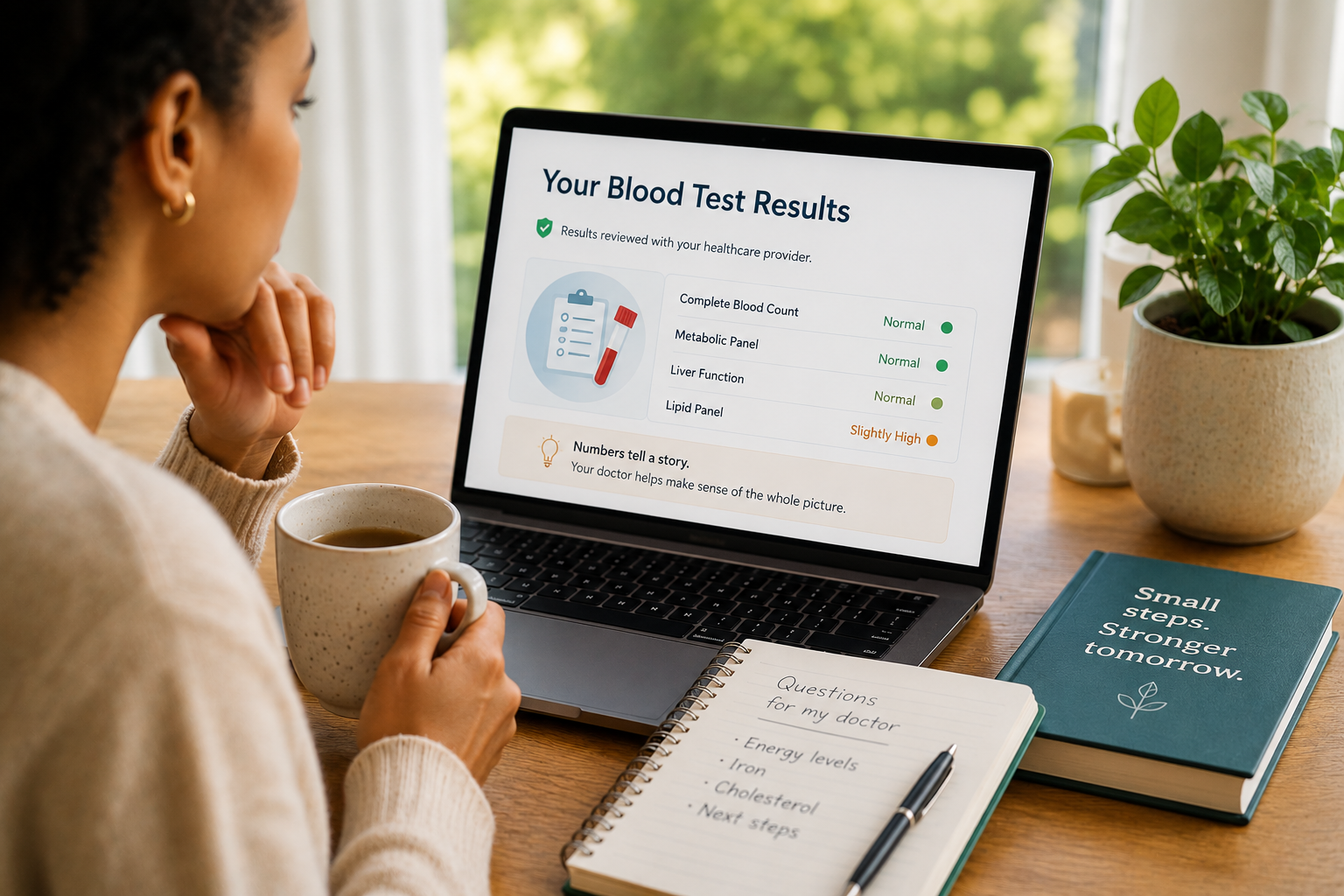
7 Surprising Things Your Blood Test Results Are Really Telling You, and How to Read Them
This article is for informational purposes only and does not constitute medical advice. Please consult a qualified healthcare provider for personalized guidance.
You open your lab portal, spot a few red numbers, and your stomach drops.
It is an easy moment to spiral. But blood test results are not meant to be read like a pass-or-fail scorecard. One “high” or “low” number does not automatically mean disease. Standard reference ranges usually cover the central 95% of results from a healthy reference population, which means some healthy people will still fall outside the range on any given test. Recent clinical reviews also stress that lab results make the most sense when interpreted alongside symptoms, medical history, medications, and repeat testing over time (Doles et al., 2025).
That is why good clinicians do not rely solely on color-coded flags. They look for patterns. They ask whether the result is new, whether it aligns with what the person is feeling, and whether everyday factors such as dehydration, recent exercise, menstruation, supplements, or medications could explain it (Doles et al., 2025).
This guide breaks down the most common blood test panels and explains what they may be telling you in plain language.
1. “Abnormal” does not always mean unhealthy
A lab’s “normal” range is a statistical tool, not a bright line between healthy and sick. These ranges can vary by testing method, lab equipment, age, sex, and population. That is why a mildly abnormal result can still happen in a healthy person, and a normal result does not always rule out a health issue (Doles et al., 2025).
This is one reason doctors care so much about trends. A number that is slightly off but stable may be less concerning than a number that has changed quickly. It is also why a repeat test is often the next step when something looks mildly abnormal but does not fit the rest of the picture (Doles et al., 2025).
2. A CBC is really three tests in one
A complete blood count, or CBC, measures the main cells in your blood: red blood cells, white blood cells, and platelets. MedlinePlus explains that a CBC helps evaluate conditions such as anemia, infection, inflammation, clotting problems, and some blood disorders (MedlinePlus, 2024a).
Red blood cells show how well your blood carries oxygen.
Red blood cells, hemoglobin, and hematocrit help tell the story of oxygen delivery. When they are low, clinicians often think about anemia. When they are high, dehydration, smoking, chronic low-oxygen states, or less common blood disorders may be part of the conversation. CBC interpretation reviews indicate that these values are most useful when read together, not alone (Erhabor et al., 2021; MedlinePlus, 2024b).
The red cell indices can hint at why anemia is happening.
MCV, MCH, MCHC, and RDW look technical, but they help sort through anemia patterns. A low MCV may suggest iron deficiency or thalassemia. A high MCV may raise questions about vitamin B12 deficiency, folate deficiency, alcohol use, liver disease, or certain medicines. These patterns are clues, not a diagnosis, but they often help guide the next test (Erhabor et al., 2021).
White blood cells can reflect infection, stress, or inflammation.
White blood cells are part of the immune system. A CBC differential breaks them into types such as neutrophils, lymphocytes, and eosinophils. Higher neutrophil counts may occur with bacterial infection or steroid use. Higher lymphocyte counts can be seen with some viral illnesses. Higher eosinophils may be linked to allergies, asthma, or parasites. Low white blood cell counts can occur with some viral infections, certain medicines, or bone marrow suppression. The key is that the pattern matters more than one isolated value (MedlinePlus, 2024a; Erhabor et al., 2021).
Research also suggests some CBC-related inflammatory markers are associated with cardiovascular and metabolic risk, but they are not stand-alone screening tools for those conditions (Seo et al., 2022).
Platelets are one piece of the bleeding and clotting picture.
Platelets help blood clot. A low platelet count can increase the risk of bleeding. A high count may happen after infection, inflammation, surgery, or iron deficiency, and less commonly with bone marrow conditions. What matters most is the combination of platelet count, the rest of the CBC, and symptoms such as bruising or bleeding (MedlinePlus, 2024a; Erhabor et al., 2021).
3. A metabolic panel is about patterns, not isolated numbers
A basic or comprehensive metabolic panel checks blood chemistry markers, including electrolytes, glucose, and kidney markers. The comprehensive panel also includes proteins and liver-related tests. These panels work best when interpreted as a group, because related values often paint a clearer picture together than they do individually (Khattak et al., 2023).
Electrolytes often reflect hydration as much as disease.
Sodium, potassium, chloride, and bicarbonate help regulate fluid balance, nerve signaling, muscle function, and acid-base balance. Mild shifts can happen from dehydration, vomiting, diarrhea, medications, kidney problems, or hormone issues. Potassium deserves extra attention because very high or very low levels can affect heart rhythm. Still, small changes are often interpreted in the context of symptoms and the rest of the panel (Khattak et al., 2023).
Glucose is one clue, not the whole diabetes story.
A blood glucose value can help screen for or monitor diabetes, but one result does not always tell the whole story. Fasting status, illness, stress, and certain medications can all affect glucose. That is why clinicians often pair glucose with hemoglobin A1c or repeat testing before making major conclusions (Khattak et al., 2023).
4. Creatinine does not equal kidney function all by itself
Kidney-related bloodwork usually includes creatinine, blood urea nitrogen (BUN), and estimated glomerular filtration rate (eGFR). Of these, eGFR gets the most attention, but it is an estimate, not a direct measurement. It is calculated using creatinine levels alongside factors such as age, sex, and body size, and its accuracy can be affected by both the method of creatinine measurement and individual characteristics, such as muscle mass (National Institute of Diabetes and Digestive and Kidney Diseases [NIDDK], n.d.-a, n.d.-b).
That last point matters more than most people realize. The muscles produce creatinine. A person with low muscle mass may have a lower creatinine level, not because their kidneys are working exceptionally well, but simply because their muscles produce less of it. A borderline eGFR in that context may need repeat testing before it means much, especially if the person was recently dehydrated or ill. Current practice uses a race-free calculation framework, known as the CKD-EPI equation, to estimate eGFR in adults (NIDDK, n.d.-c).
5. “Liver function tests” is a misleading label
Many people use the phrase “liver function tests,” but it is not perfectly accurate. Some of these markers reflect liver cell injury. Others reflect bile flow. Others reflect how well the liver makes proteins. That is why clinicians look at the full pattern, not one enzyme in isolation. A recent BMJ Practice Pointer makes this point clearly (Stewart et al., 2025).
ALT and AST can rise for different reasons
ALT and AST are enzymes that may go up when liver cells are irritated or injured. ALT is generally more liver-specific than AST, while AST can also rise with muscle injury and some non-liver conditions. Abnormal results may be related to fatty liver disease, alcohol use, viral hepatitis, medication effects, or other causes. Still, the result only becomes meaningful when read with symptoms, risk factors, and the rest of the panel (Stewart et al., 2025).
Alkaline phosphatase and bilirubin tell a different kind of story.
Alkaline phosphatase may rise when bile flow is blocked, but it can also increase because of bone activity, growth, or pregnancy. Bilirubin may rise when the liver is not processing it properly, bile flow is blocked, or red blood cells are being broken down more quickly than usual. Those are very different mechanisms, which is why doctors often order follow-up testing rather than jumping to conclusions after a single abnormal result (Stewart et al., 2025).
6. A cholesterol panel is mostly about future risk
A lipid panel usually includes total cholesterol, LDL cholesterol, HDL cholesterol, and triglycerides. The CDC explains that cholesterol is essential for health, but too much cholesterol in the blood can raise the risk of heart disease and stroke. High cholesterol usually does not cause symptoms, which is why blood testing matters (CDC, n.d.).
That means a lipid panel is usually not about how you feel today. It is about long-term cardiovascular risk. Doctors interpret these numbers alongside age, blood pressure, diabetes, smoking history, family history, and a history of heart disease or stroke (CDC, n.d.).
7. The most important blood test skill is knowing when not to panic
Most routine lab abnormalities are not emergencies. Many mildly abnormal results can be discussed at a regular appointment, especially if you feel fine. But a quicker follow-up is needed if abnormal blood tests are accompanied by symptoms such as chest pain, shortness of breath, fainting, confusion, yellowing of the skin or eyes, unusual bleeding, black or bloody stools, severe weakness, low urine output, or high fever (Stewart et al., 2025).
Before assuming the worst, use this checklist:
Look for patterns — Is one value slightly off, or are several related values moving together?
Compare with older results — A stable mild abnormality may mean something very different from a sudden change.
Think about recent factors — Were you sick, dehydrated, fasting, or exercising hard?
Review medications and supplements — Many common drugs and supplements can affect liver enzymes, kidney markers, electrolytes, or blood counts.
Match the numbers to symptoms — Lab values matter most when they line up with what is happening in your body (Doles et al., 2025).
The bottom line
Blood tests are powerful tools, but they are not meant to be interpreted in fear or in isolation. A CBC can offer clues about anemia, infection, inflammation, and clotting. A metabolic panel can reveal shifts in hydration, glucose, electrolytes, kidney function, and liver markers. A lipid panel can help estimate heart risk long before symptoms appear. The most useful interpretation comes from patterns, trends, and clinical context (Doles et al., 2025; Stewart et al., 2025).
Save this. The next time you open a lab report and see a number in red, come back to this guide before jumping to conclusions. For more plain-language health education, explore CareThrive’s health library.
References
Centers for Disease Control and Prevention. (n.d.). About cholesterol. Retrieved May 26, 2026, from https://www.cdc.gov/cholesterol/about/index.html
Doles, N., Mon, M. Y., Shaikh, A., Mitchell, S., Patel, D., Seehusen, D., & Singh, G. (2025). Interpreting normal values and reference ranges for laboratory tests. The Journal of the American Board of Family Medicine, 38(1), 174–179. https://doi.org/10.3122/jabfm.2024.240224R1
Erhabor, O., Muhammad, H. A., Muhammad, K., Onwuchekwa, C., & Egenti, N. B. (2021). Interpretation of full blood count parameters in health and disease. Hematology International Journal, 5(1), 00180. https://doi.org/10.23880/hij-16000180
Khattak, Z. E., Salen, P., Petersen, F., & Khojandi, A. (2023). Overview of ordering and evaluation of laboratory tests. In StatPearls. StatPearls Publishing. https://www.ncbi.nlm.nih.gov/books/NBK570615/
MedlinePlus. (2024a, October 15). Complete blood count (CBC): MedlinePlus medical test. U.S. National Library of Medicine. https://medlineplus.gov/lab-tests/complete-blood-count-cbc/
MedlinePlus. (2024b, October 14). CBC blood test. U.S. National Library of Medicine. https://medlineplus.gov/ency/article/003642.htm
National Institute of Diabetes and Digestive and Kidney Diseases. (n.d.-a). Clinical measurements & eGFR accuracy. https://www.niddk.nih.gov/research-funding/research-programs/kidney-clinical-research-epidemiology/laboratory/factors-affecting-egfr-accuracy/clinical-measurements
National Institute of Diabetes and Digestive and Kidney Diseases. (n.d.-b). Demographics & eGFR accuracy. https://www.niddk.nih.gov/research-funding/research-programs/kidney-clinical-research-epidemiology/laboratory/factors-affecting-egfr-accuracy/demographics
National Institute of Diabetes and Digestive and Kidney Diseases. (n.d.-c). eGFR equations for adults. https://www.niddk.nih.gov/research-funding/research-programs/kidney-clinical-research-epidemiology/laboratory/glomerular-filtration-rate-equations/adults
Seo, I.-H., Lee, J.-H., Kim, G.-S., Park, J.-M., Kim, M.-J., Lee, B.-W., Kang, E.-S., Cha, B.-S., & Lee, H.-C. (2022). Usefulness of complete blood count (CBC) to assess cardiovascular and metabolic diseases in clinical settings: A comprehensive literature review. Biomedicines, 10(11), 2697. https://doi.org/10.3390/biomedicines10112697
Stewart, S., Distante, S., Duke, N., & Shearman, J. (2025). Interpreting abnormal liver blood test results. BMJ, 391, e082648. https://doi.org/10.1136/bmj-2024-082648